
UET30621 Certificate III in ESI – Distribution Overhead
About
Launch your career in the Electricity Supply Industry (ESI) and gain the specialist skills required to work as a Distribution Overhead Lineworker. This apprenticeship program blends on-the-job experience with structured training in our industry-leading facilities, preparing you to work confidently and safely across overhead power distribution networks.
This nationally accredited qualification provides the skills and knowledge needed to install, maintain and inspect poles, structures, hardware, electrical apparatus and associated overhead equipment. You’ll learn to use support plant, tools and specialised equipment while applying industry standards, safety procedures and network requirements to complete overhead distribution work to the highest standard. The application of the skills and knowledge contained within this qualification may require accreditation and/or authorisation to practise in the workplace.
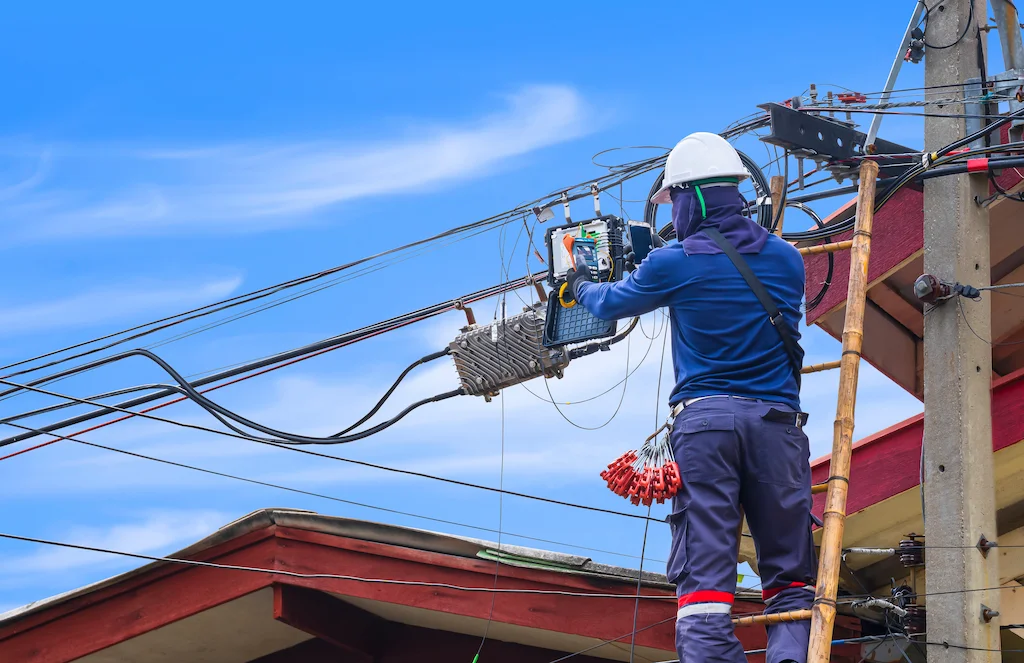
The ESI Distribution Overhead sector is essential to delivering safe and reliable electricity to homes, businesses and communities. It includes tasks such as constructing and maintaining overhead lines, installing and replacing poles and crossarms, operating elevated work platforms and live-line tools, and responding to network faults and emergencies.
Lineworkers in this field work closely with network operators, vegetation management teams, civil contractors and other ESI specialists to ensure the ongoing performance and resilience of Australia’s overhead power infrastructure.
If you’re seeking a hands-on, physically active and highly valued role within the electricity supply industry, this qualification provides a strong foundation for a rewarding career.

Learning Outcomes
At the successful completion of this qualification, you will be able to:
- Install, assemble and erect overhead distribution network assets, including poles, crossarms, hardware and electrical apparatus.
- Construct and maintain overhead conductors, cables and associated equipment in accordance with network standards and workplace procedures.
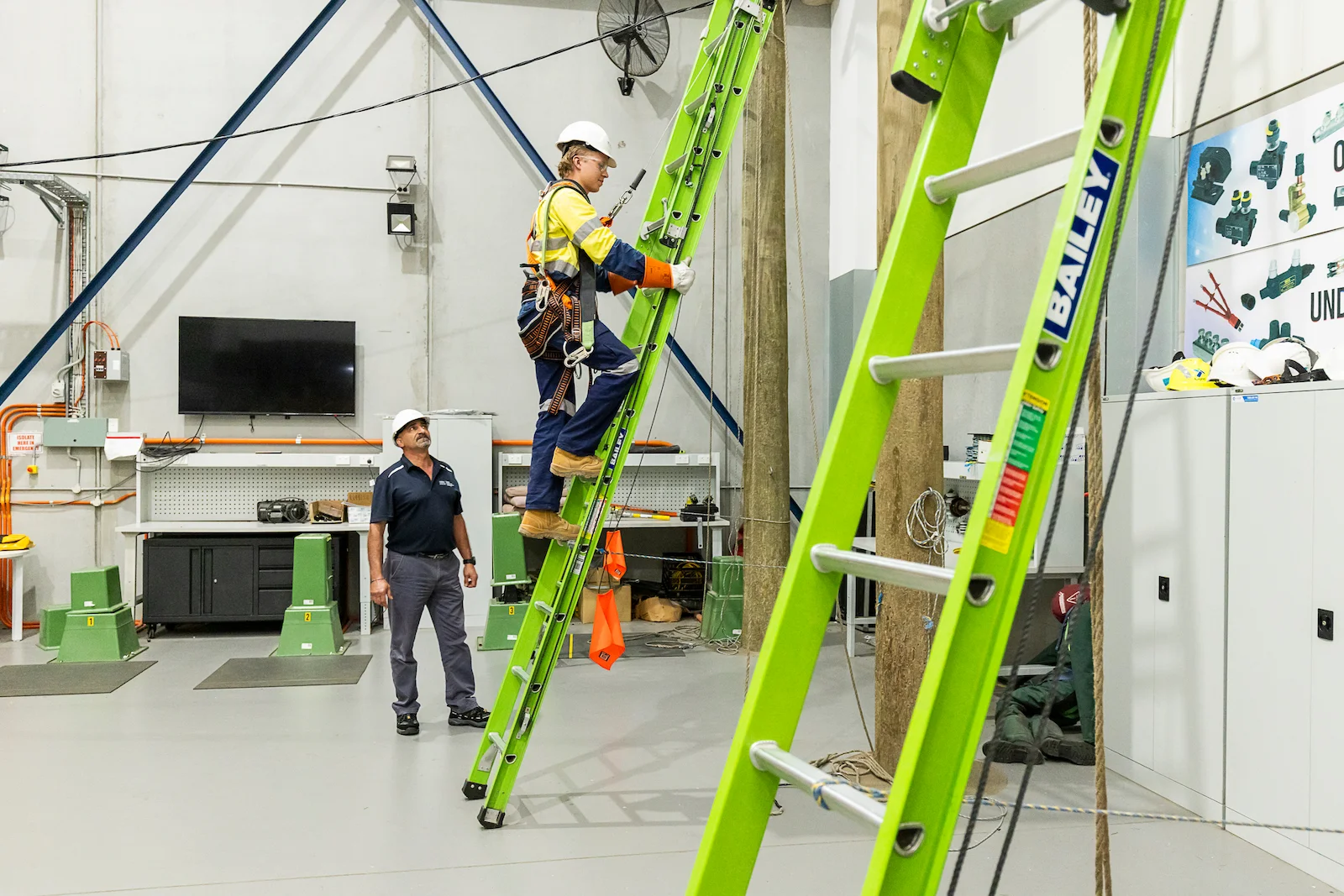
- Use elevated work platforms (EWPs), lifting equipment and support plant safely and effectively during overhead construction tasks.
- Conduct routine inspection and maintenance of overhead distribution assets to ensure ongoing network safety and reliability.
- Identify and diagnose faults in overhead systems and assist in restoring supply using approved tools, techniques and procedures.
- Comply with WHS/OHS requirements, network operator standards, and regulatory obligations for working on overhead electrical infrastructure.
- Apply electrical theory relevant to overhead distribution systems, including conductor behaviour, fault currents, clearances and protection principles.
- Read and interpret network drawings, line diagrams, construction plans and manufacturer specifications.
- Use and maintain specialised tools, instruments and equipment required for overhead linework.
- Demonstrate teamwork and collaboration on live worksites, particularly during high-risk operations and fault response activities.
Career pathways
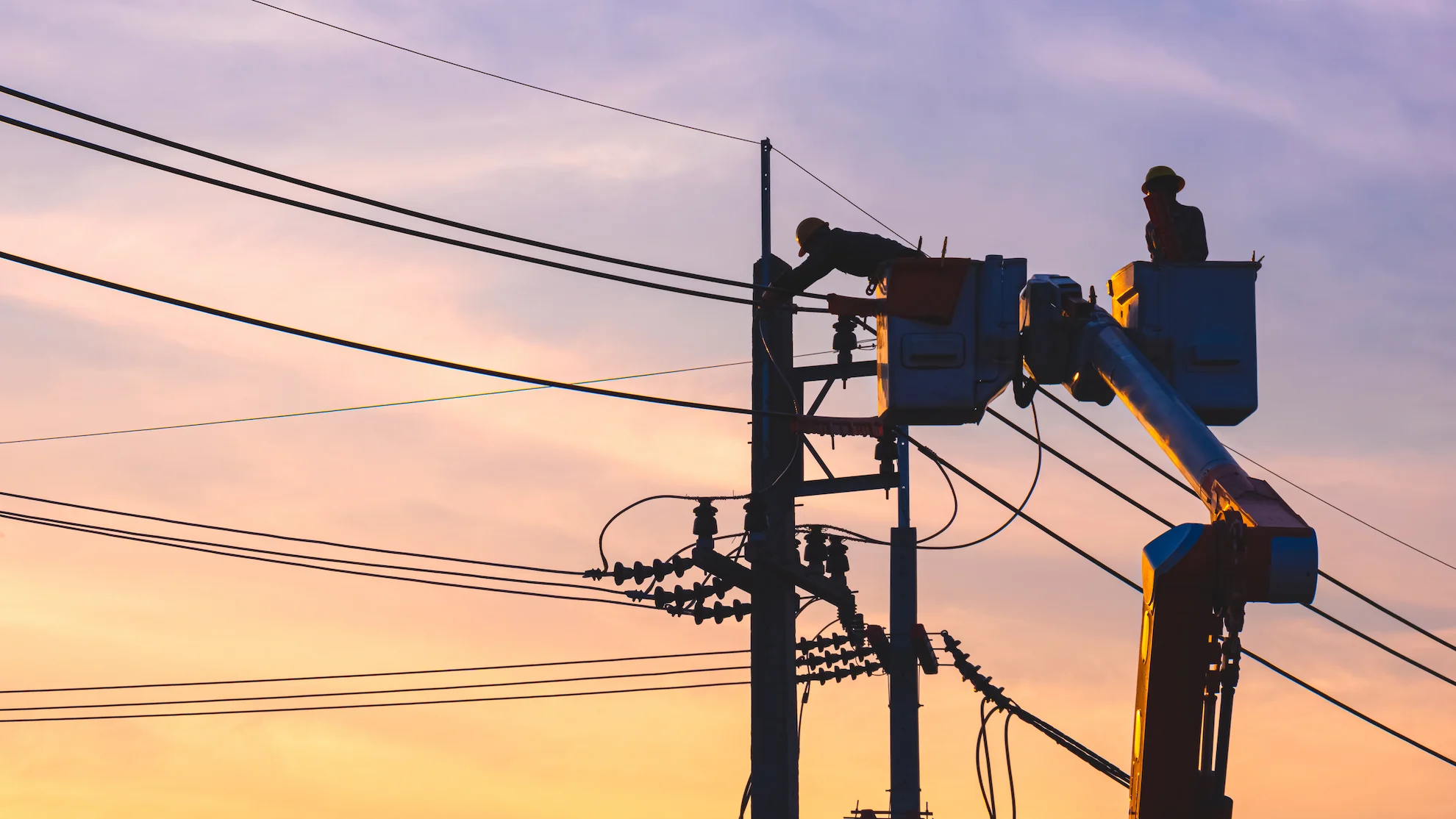
As Australia’s overhead electricity networks continue to expand, upgrade and adapt to support smart grids, decentralised energy systems and growing communities, the demand for skilled Lineworkers remains strong. These technicians play a critical role in constructing, maintaining and repairing the infrastructure that delivers electricity to homes, businesses and industry.
Distribution Lineworkers are vital to ensuring that electricity networks remain safe, resilient and responsive, particularly as the sector continues to evolve through new technologies, significant infrastructure investment and ongoing network renewal.

Licensing
The skills and knowledge in this qualification may require state specific accreditation to practice in Australia. Competency development activities in this qualification are also subject to regulations directly related to accreditation. Where accreditation is not held, a relevant contract of training through an Australian Apprenticeship, may be required.
Is this qualification right for you?

This qualification may be right for you if:
- You enjoy practical outdoor work and are comfortable working in varied conditions, including at heights, on poles and from elevated work platforms.
- You have good physical fitness and coordination, enabling you to safely climb structures, use rigging equipment and handle heavy tools and materials.
- You are interested in overhead distribution systems, including the installation, maintenance and inspection of poles, hardware and electrical apparatus.
- You have strong attention to detail and can follow safety procedures, network standards and work instructions with precision.
- You enjoy practical, problem-solving work, using a logical approach to install, maintain, diagnose and repair systems.
- You work well in a team environment, communicating effectively with supervisors, line crews and network control to complete high-risk tasks safely.
- You’re committed to building technical skills, including interpreting construction plans, using specialist equipment and applying electrical theory in real-world situations.
Study Options
Frequency & Expected duration
This qualification nominally takes 4 years to complete, which typically includes around three years of combined off-and-on-the-job training, and around one year of dedicated on-the-job training.
During the first 3 years you will be required to attend 40 days of training each year, at one of our industry-leading facilities for in-person training.
NECA Training delivers off-the-job training via the traditional 1 day/week for 40 weeks with ‘term breaks’ at regular intervals, and through Block Release, involving 5 to 10 days full time training, multiple times each year.
Location
We currently deliver this qualification from our Centre of Excellence in Fyshwick (ACT), which is a purpose-built technical trade college, owned by the Industry.
Entry Requirements
To start the UET30621 Certificate III in ESI – Distribution Overhead, you must be employed, have a Unique Student Identifier, meet basic Language, Literacy, Numeracy and Digital Literacy requirements, and meet any specified Australian Government and State/Territory eligibility criteria.
Unique Student Identifier (USI)
A Unique Student Identifier (USI) must be provided at the time of enrolment for this qualification.
Your USI is your personal education number and it is required for all nationally recognised study, including university and vocational education and training (VET). Made up of 10 letters and numbers, it is free and stays with you for life.
If you haven’t previously done so, you can create your USI here – https://www.usi.gov.au/
Apprenticeships
To commence your studies with NECA Training, you must be working as an apprentice and have a signed apprenticeship contract lodged with an Apprentice Connect Australia Provider (ACAP).
You have a few options to begin an electrical apprenticeship.
You can apply for a position with a Group Training Organisation (GTO), such as NECA Electrical Apprenticeships. The GTO then becomes your legal employer and makes arrangements for you to undertake direct work placements with one or more trusted host employers.
For direct employment, we encourage you to look online, check local newspaper ads or on-line employment platforms and/or contact local electricians to see if they employ apprentices.
Once you have found a job, your employer will register you with an Apprenticeship Connect Australia Provider (ACAP) who will further support you through the process.
Language Literacy Numeracy & Digital Literacy (LLND)
To successfully complete this qualification it is essential that you have adequate Language, Literacy, and Numeracy (LLN) skills as well as Digital Literacy skills to engage fully with the training materials, participate in learning activities, and complete all required assessments. This includes the ability to:
- Read and interpret learning materials and assessment instructions
- Write responses and communicate effectively in English
- Apply numeracy skills such as measuring, calculating, and interpreting data
- Use digital tools such as learning management systems, electronic work record systems and other online or computer-based platforms relevant to the training.
The LLND requirements for this qualification are broadly aligned with Level 3 in the Australian Core Skills Framework (ACSF). ACSF Level 3 indicates a competent level of performance in core skills that is sufficient for meeting the demands of everyday life and work.
Prior to enrolment, you will be required to complete an LLN assessment so that we can better understand your individual needs, and assist to ensure your LLN skills match the demands of the qualification.
Qualification Structure
The UET30621 Certificate III in ESI – Distribution Overhead qualification requires the completion of 20 Core Units of Competency and 4 Elective Units.
Delivery order
Unit Code Unit Name UEECD0007 Apply work health and safety regulations, codes and practices in the workplace UEECD0046 Solve problems in single path circuits UEECD0044 Solve problems in multiple path circuits UEECD0019 Fabricate, assemble and dismantle utilities industry components UETDREL005 Work safely in the vicinity of live electrical apparatus UETDREL001 Apply environmental requirements CPCCLDG3001 Licence to perform dogging TLILIC0005 Licence to operate a boom-type elevating work platform (boom length ≥11 metres) AHCMOM213 Operate and maintain chainsaws UEEEL0021 Solve problems in magnetic and electromagnetic devices UEECD0051 Use drawings, diagrams, schedules, standards, codes and specifications UEEEL0020 Solve problems in low voltage a.c. circuits UETDREL004 Operate plant and equipment in the vicinity of live electrical apparatus UETDRDO001 Inspect overhead poles, structures and electrical apparatus UETDRIS012 Install and maintain poles, structures and hardware UETDRIS007 Install and maintain distribution overhead conductors and cables UETDRIS008 Install and maintain electrical apparatus UETDRDO005 Maintain overhead energised low voltage distribution network UETDRIS010 Install and maintain low voltage overhead services UETDRIS011 Install and maintain low voltage underground services UETDRIS013 Install and maintain public lighting systems UETDRIS018 Perform low voltage field switching operation to a given schedule UETDRIS017 Perform high voltage field switching operation to a given schedule UETDRDO006 Maintain, test and verify distribution overhead network Credit Transfer
Credit Transfer
NECA Training accepts and provides credit to learners who have already completed Units of Competency from the qualification, unless licensing or regulatory requirements prevent this.
To receive a credit transfer for a unit you must provide us with formal evidence that you’ve previously completed the unit or a unit which matches in content and outcome. Formal evidence can be a qualification certificate or transcript, statement of attainment or your USI transcript. When credit is recognised, you don’t need to repeat training or assessment for that unit.
Recognition of Prior Learning (RPL)
Recognition of Prior Learning (RPL)
Recognition of Prior Learning (RPL) is an assessment process that evaluates the competency you may have acquired through previous education and training, work experience and/or life experience and knowledge. In a RPL process, evidence is collected and assessed to determine the extent to which you meet the pre-determined performance standards contained within the associated Unit/s of Competency being considered for RPL.
While some may view RPL as a shortcut to competency, it is important to understand that sufficient evidence to meet each element and performance criteria and all assessment requirements within the Unit/s of Competency still needs to be collected and assessed before a final competency decision can be reached.
If you believe you are eligible for RPL, please let our administration team know during the enrolment process so that we can better support your application.

Fees & Charges
For all NSW-based students, this training is subsidised by the NSW Government under their Smart and Skilled program. This means that it is fee free for all eligible students.
For ACT-based students, the Government funding covers the majority, but not all, of the costs. The deficit is made up through course fees and other funding that is invoiced to your employer each semester. The total course fees (i.e.; the funding component not covered by the ACT Government) are $7,670.
Intakes
Given the specialised nature of UET30621, training intakes are scheduled on a needs basis rather than at set times throughout the year. Classes commence only when there is sufficient industry demand, ensuring that training aligns with workforce requirements and employer needs.
New groups are typically formed following direct consultation with employers, allowing us to tailor delivery to specific project timelines, crew structures or operational requirements within the Electricity Supply Industry (ESI).
If your organisation is considering enrolling apprentices or requires customised training delivery, please contact us to discuss upcoming opportunities and potential intake arrangements.